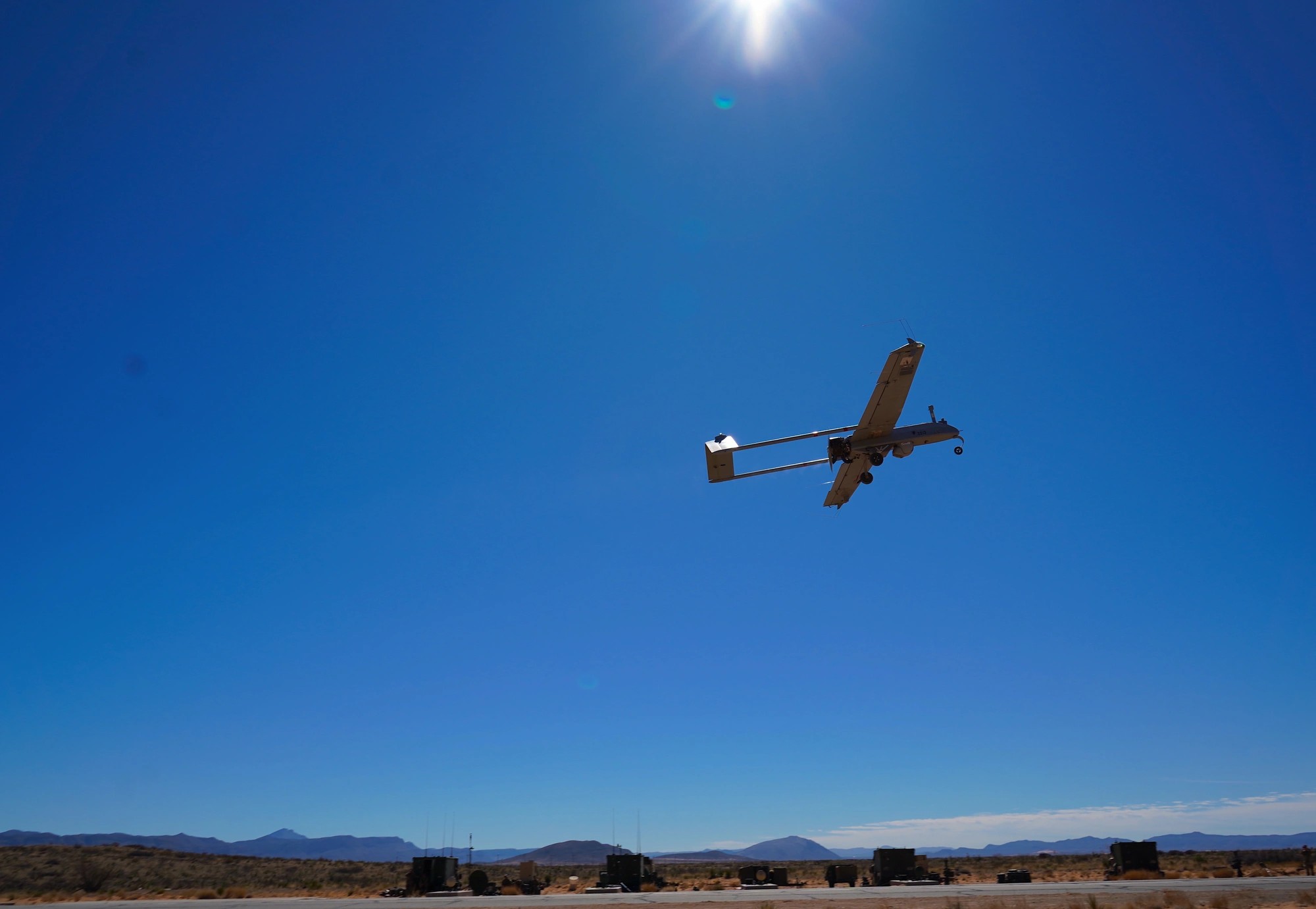
Der Himmel lebt — the sky is alive. German soldiers training alongside Ukrainian veterans brought the phrase home. It describes a front where twenty-five to fifty drones from both sides hang over every ten kilometres at any given moment. Observation is effectively total for the first three kilometres behind the line of contact, thins out to fifteen, and can be tasked onto anything out to forty. From those measurements the analytic consensus of 2022 and 2023 drew a short conclusion: concealment is finished, and operational surprise with it. Jack Watling of RUSI — the London defence institute whose field teams have measured the Ukrainian front more systematically than anyone — gave the consensus its definitive sentence: “If forces move, they will be detected.”
The measurements stand. The absolute sentence built on them has not survived — and the correction came from the author’s own institute. By 2025, the same research programme was describing not a law but a gradient: dense here, thinner there, with edges that can be worked. Its fieldwork found that localised gaps in the enemy’s reconnaissance coverage can be generated: by rain; by the twice-daily window in which thermal sensors go half-blind; by jamming umbrellas; by hunting the enemy’s reconnaissance drones before an offensive starts. A law admits no exceptions. A gradient is an engineering problem. And this one has three known limits: it thins with depth, it stops at the surface of the earth, and it has an inside.
The first essay in this series opened with the deduction that whatever emits will be found — and with its break condition: the transparent battlefield could turn out cluttered rather than clear. That edge is no longer hypothetical. Since the absolute sentence was written, four operations have moved forces through sensor-saturated space without being understood in time to matter.
February 2022 is the strangest case, because Russia achieved surprise underneath total detection. The build-up was photographed from orbit for months, and Washington published its intelligence in advance. The sensors worked completely. Kyiv, Berlin and much of the analytic world filed the imagery under coercion rather than invasion. A battlefield can be perfectly seen and completely misread, and no satellite constellation closes a gap that lives inside organizations.
Two operations in June 2025 started from the far side of the sensors. Ukraine’s Spider’s Web strike smuggled roughly 150 drones into Russia under commercial cover, staged them for over a year and a half, and flew them against strategic bomber bases from inside the country. Less than two weeks later, Israel achieved total surprise against an Iran expecting attack: strike teams and weapons pre-positioned in-country, fired from inside the defences’ own envelopes. Both were surprise by pre-positioning. An operation that begins behind the sensors is not an exception to the gradient but proof that it has an interior.
The manual
The purest counterexample beat the sensors in their home domain — ground manoeuvre, on the war’s own front, under the war’s own drone density. On 6 August 2024, Ukrainian forces crossed into Kursk oblast, and after eighteen days held some 1,250 square kilometres of Russian territory. The verdict came from the institution with the strongest incentive to believe surprise was dead: thirteen days in, the intelligence arm of the US Army’s own doctrine command assessed that Ukraine had “overcome the transparent battlefield”.
The mechanics read like a manual. Shrink the knowledge: General Syrskyi, Ukraine’s commander-in-chief, planned the offensive face-to-face with a handful of senior officers, leaving no digital traces to harvest; the assault force learned its mission hours before crossing. Poison the interpretation: a disinformation line insisted no counteroffensive was possible before spring 2025, while the 61st Mechanized Brigade moved toward Vovchansk so convincingly that senior Ukrainian officers believed it the real axis. Pick the blind spot: Kursk’s reconnaissance coverage, fires and defences were the weakest on the front — conscripts holding a border Moscow trusted its nuclear red line to protect. Then put out the eyes: first-person-view attack drones, the cheap strike weapon of this war, flew instead as air defence against Russia’s Orlan reconnaissance drones, while electronic warfare degraded Russian command links. None of it required air superiority, stealth or anything exquisite. The blindness was manufactured from the same cheap components that create the transparency.
The autopsy
The autopsy is the more important half of the story. Ukraine withdrew from Sudzha on 13 March 2025 — seven months, nearly to the day, after the crossing — and the surprise of August had purchased no strategic decision. The salient hung on a single supply road, from Sumy to Sudzha, and Russia strangled it with the fibre-optic FPV: a drone steering down a hair-thin cable, immune to jamming because nothing about it broadcasts. The type was developed as a direct answer to the incursion and fielded against exactly that road. Ukraine reportedly lost a quarter more vehicles than Russia in the sector; a Ukrainian medic supplied the epitaph: “Our logistics just collapsed.” North Korean infantry, glide bombs and the spring mud all helped; none of that changes the arc. The operation that undercut the transparent battlefield was ended by the gradient restoring itself over the one road that mattered. Blinding opens a window; it does not furnish the room. Manufactured blindness buys time — the receipt says seven months — and time is all it buys.
Four successes, though, are a numerator without a denominator. Nobody knows how many attempted surprises died in their assembly areas, because failure at that stage looks like nothing happening. The four falsify the absolute; they do not license its opposite. And the gradient reading names its own exits. It breaks if blinding operations of the Kursk class fail serially over the next few years — August 2024 would then stand as the exception that measured the rule. It breaks the other way if one of them ever converts surprise into a decision rather than into time.
Which matters because both absolutes have salesmen. “Everything is seen” underwrites sensor constellations; a ministry quoting the 2022 sentence in a 2027 budget is buying a snapshot of a battlefield actively learning to fog. “Camouflage works again” is the Maginot argument with the sign reversed: permanent cover promised on a few expensive, local, time-limited exceptions — one of them already ground back down. The honest question to put to any defence ministry is a ratio: how much does the budget spend on seeing, and how much on being wrongly seen? Most budgets answer millions against a rounding error — pricing the next war on the assumption that the other side has not read the manual. The sky is alive — but not everywhere, not equally, and not for free. The side that plans on the gradient will keep surprising the side that planned on the law.